Whitcross
Whitcross is not a town or even a hamlet but a stone pillar set up where four roads meet, whitewashed to be visible at a distance and in darkness. Four arms spring from its summit, pointing to towns whose names tell Jane in what county she has landed: a north-midland shire, dusk with moorland, ridged with mountain. Great moors stretch behind and on every side; waves of mountains rise far beyond the deep valley at her feet. The roads stretch out east, west, north, and south—white, broad, lonely—all cut in the moor, with heather growing deep and wild to their very verge. It is here, on a summer evening, that the coachman sets her down, unable to take her farther for the sum she has given, and she discovers she has forgotten to take her parcel out of the pocket of the coach, where she had placed it for safety. She is now absolutely destitute, without another shilling in the world.
A Threshold of Desolation
Whitcross functions as the geographical and symbolic nadir of Jane's flight. She has left Thornfield with only twenty shillings, and now even that meagre resource has been exhausted by the coach fare. The crossroads offer no shelter, no community, no hope of aid: the population is thin, and she sees no passengers on the roads. A chance traveller might pass by, but she wishes no eye to see her, for strangers would wonder what she is doing lingering at the sign-post, evidently objectless and lost. She could be questioned, but she could give no answer that would not sound incredible and excite suspicion. Not a tie holds her to human society at this moment; not a charm or hope calls her where her fellow-creatures are. None who saw her would have a kind thought or a good wish for her. She has no relative but the universal mother, Nature, and she decides to seek her breast and ask repose.
The Descent into the Moor
From Whitcross, Jane strikes straight into the heath, holding on to a hollow that deeply furrows the brown moorside. She wades knee-deep in its dark growth, turns with its turnings, and finds a moss-blackened granite crag in a hidden angle, where she sits down under it. High banks of moor are about her; the crag protects her head; the sky is over that. Here she passes her first night, eating the remnant of a roll she had bought with her last coin and gathering ripe bilberries that gleam like jet beads in the heath. She folds her shawl double and spreads it over her for a coverlet, using a low, mossy swell as her pillow. Her rest is broken by a sad heart that plaints of its gaping wounds, its inward bleeding, its riven chords, trembling for Mr. Rochester and his doom. She rises to her knees to pray, and looking up with tear-dimmed eyes at the mighty Milky Way, she feels the might and strength of God, turns her prayer to thanksgiving, and nestles again to the breast of the hill, ere long forgetting sorrow in sleep.
The Morning of Want
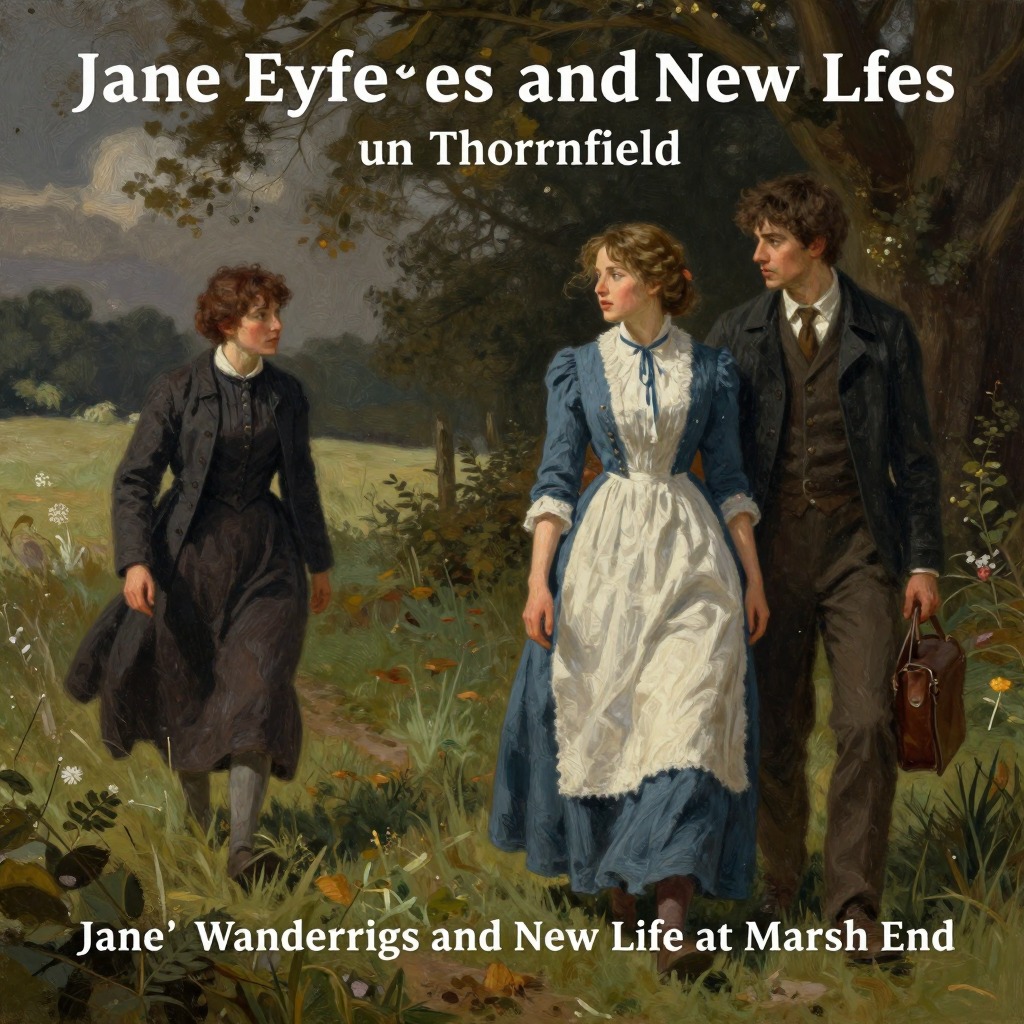
But the next day, Want comes to her pale and bare. Long after the little birds have left their nests, long after bees have come in the sweet prime of day to gather heath honey before the dew is dried, she gets up and looks round her. It is a still, hot, perfect day—a golden desert of spreading moor, everywhere sunshine. She wishes she could live in it and on it, become a bee or lizard to find fitting nutriment and permanent shelter. But she is a human being with a human being's wants, and she must not linger where there is nothing to supply them. She rises, looks back at the bed she has left, and wishes that her Maker had that night thought good to require her soul of her while she slept. Life, however, is yet in her possession, with all its requirements, pains, and responsibilities. The burden must be carried; the want provided for; the suffering endured; the responsibility fulfilled. She sets out, regains Whitcross, and follows a road leading from the sun, now fervent and high, with no other circumstance to decide her choice. It is from this point that she begins her long walk toward the hamlet whose church bell she will hear, and toward the eventual shelter offered by the Rivers family at Marsh End.
Narrative Significance
Whitcross is the pivot on which Jane's story turns from flight to wandering. It is the place where she is stripped of every external support—money, connections, identity—and reduced to her barest self. The crossroads, with its four arms pointing to towns ten and twenty miles distant, literalizes her condition of radical choice and radical uncertainty. She has no map, no destination, no plan beyond the immediate necessity of survival. The whitewashed pillar, visible in darkness, becomes a kind of anti-beacon: it marks not a place of arrival but a place of departure from everything she has known. In the novel's geography of thresholds—Gateshead, Lowood, Thornfield, Moor House, Ferndean—Whitcross is the most exposed and the most liminal, a point where the narrative pauses to register the full weight of Jane's homelessness before it begins the slow work of rebuilding her life.